Reflecting on (my) misogyny as a gay man
I've only read part of the journal article cited at the bottom of this post, and after I had written everything but my conclusion. I wanted to include it because it had a great quote that demonstrates my main point in a better way that I could. From what I read, it's very interesting and eye-opening. If you get the chance to read it in full (like I will be doing), I hope it is helpful in your own reflections on misogyny.
I like to say I'm a feminist. I did, after all, vote for Hillary Clinton in my school's fake 2016 Presidential election /s. And I like to be true to whatever I identify myself as.
Since I want to be a true feminist, I have been reflecting on my own misogyny and concluded that I still have so much work to do. To any women reading this (hey!), you probably aren't surprised. But the reason I thought I might be built different is because of my homosexuality. Much of the misogyny that is called out comes from straight men, and the misogyny that comes from gay men has been largely ignored. That isn't to say that no one has called out that brand of misogyny, but that the attention it receives is much lower than that which is given to what straight men say.
As I've previously talked about on my blog, I used to be on stan Twitter. I never had a large account, but most of my timeline was constructed of other stan accounts. In case you're unaware of the demographics of stan Twitter, gay men are a large part of it. And just because much of the conversations in stan Twitter is surrounded around female pop stars, does not mean that men aren't part of the conversation (it’s a feature, not a bug).
Misogyny as most people understand it, comes from the patriarchy, of which straight men are on top. This can lead people to ignore the misogyny of gay men- we don't want to date or have sex with women, so why would we be misogynistic?
I suppose that gay men are still able to be misogynistic because of their closeness with femininity, enabling them to be agents of the patriarchal order. This is similar to, but not the same, as how women can also act in ways that enforce the patriarchy. Basically, it’s not just cisgender heterosexual men that contribute to the reinforcement of patriarchy.
Contrary to the stereotypes in pop culture, some gay men are actually hyper-masculine. For one faction, it’s a genuine portrayal of their aesthetic preferences. But for others, it’s a rejection of the stereotypical flamboyant, girly gay, with hints of inauthentic gender performance and reactivity.
Society has declared that femininity is not just something that women and girls can have. If classmate tells a young boy during P.E. that he throws like a girl, that classmate is being rude for two reasons. First, they’re saying that doing anything “like a girl”, AKA in a feminine manner, is bad. Secondly, that proximity to femininity is used as an insult. But who can blame this classmate? Pop culture has used femininity, whether expressed by women or men, as a punchline. And even when women avoid being feminine, they’re ridiculed. Not to sound like a broken record, but women can never win, blah blah blah, watch America Ferrera’s monologue from the 2023 Barbie movie.
One way that gay men are assumed to be feminine is if they are a bottom, and if you don’t know what that means… you’re either too young to be reading this (please go) or very straight (please stay!) and need to reference Urban Dictionary. What makes a bottom more feminine, and a top more masculine? The bottom is, for lack of better wording, penetrated, and the top does the penetrating. That sexual relationship between gay men mirrors the one of straight couples. But, and this should be obvious, why are we applying heteronormative notions of femininity onto homosexual couples? Being a bottom or being feminine is not caused by the other. Yet in practice, they’re treated as traits connected to each other.
To put it bluntly, there are gay men that are insecure about being perceived as feminine, so they attack other gay men for it, and even women for not adhering to traditional femininity with perfection. They uphold heteronormative rules for how gender should be performed, even if they don’t follow those rules perfectly themselves. You can observe this in conservative or M.A.G.A. gays- they object to certain labels, like queer, being used to describe them. They also tend to be unaccepting of transgender people, going so far as to distance themselves from that part of the queer community (“LGB without the T”). Deep down, they think that adhering to gender performance as closely as possible and distancing those who don’t will make them more accepted by their conservative family, church community, or just do it as a method of self-preservation.
This sentiment is perfectly encapsulated by cartoonist Adam Ellis (@adamtots on Instagram)
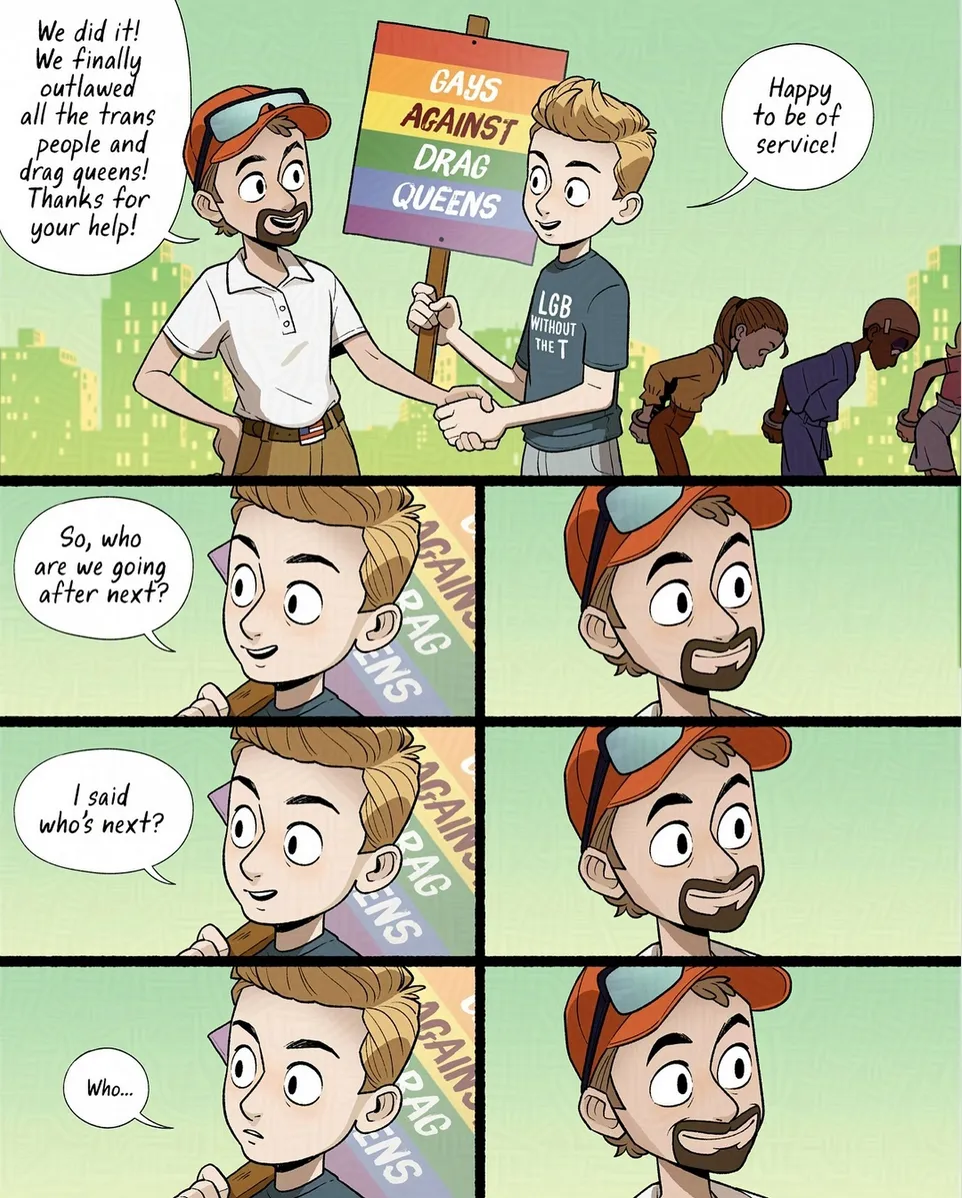
Crucially, while behaving in a feminine way will likely lead to social ostracization or violence for men, behaving in a masculine way will not – adding a layer of explanation as to why gay men may take shelter in this socially approved way of behaving.1
Tying all this to the beginning, I've caught myself being judgmental towards other gay men because they express themselves more feminine than I do. I find it both silly and hypocritical. I do have a f*gcent after all. Plus, being gay in the first place makes me too feminine in the eyes of some.
To my fellow homosexual men, please do your best to avoid making femininity the punchline for your jokes. Additionally, let everyone around you express themselves how they want to. Just because queer people are an oppressed group does not prevent group members to oppress other members. Recognize your misogyny, and reflect on it. It's OK to not like feminine traits in yourself or a potential partner, but it's not OK to express that dislike as a universal law that needs to be applied to all gay men.